
When Dorothy L. Sayers arrived in Mecklenburgh Square in 1921, she was thirty years old and embarking on a new chapter of her life.
She had studied at Somerville College, Oxford, where she achieved a first-class honours degree in Modern Languages. Although she had completed all the academic requirements years earlier, Oxford University did not formally award degrees to women until 1920. Sayers was therefore among the very first women to receive an Oxford degree, marking an important moment in the University's history as well as her own.
Armed with one of the finest educations available to a woman of her generation, she moved to London, worked as a teacher and later as a copywriter in one of Britain's most successful advertising agencies. Yet she was still some years away from becoming one of the country's most celebrated crime writers.
Her rooms at 44 Mecklenburgh Square, just a short walk from today's Goodenough Hotel, became the backdrop to that transformation.
It was here that Sayers experienced her first taste of truly independent London life. Friends remembered her as energetic, intellectually curious and full of humour. She embraced the city with enthusiasm, riding motorcycles, enjoying fast cars and, as Professor B. J. Rahn memorably puts it, "she roared around Bloomsbury."
Those years in Mecklenburgh Square proved remarkably productive. While living here she conceived the character who would define much of her literary career: Lord Peter Wimsey. She also wrote her first detective novel, Whose Body?, introducing readers to the aristocratic sleuth who would become one of the great detectives of the Golden Age of crime fiction.
Although Sayers later lived in France before settling in Great James Street, where her Blue Plaque can still be found today, it was here in Mecklenburgh Square that her remarkable literary journey truly began.

To think of Dorothy L. Sayers simply as a crime writer is to miss the extraordinary breadth of her achievements.
She was a classical scholar, respected essayist, playwright, poet, translator and theologian. Her acclaimed translation of Dante's Divine Comedy remains one of the finest English versions ever published.
She was also an outspoken public intellectual. Her essays challenged assumptions about education, creativity and the role of women in society. In Are Women Human?, she argued that women should first and foremost be recognised simply as individuals, judged by their abilities rather than their gender.
Professor Rahn describes Sayers as remarkable because of "the many facets of her brilliance." Few writers have moved so comfortably between detective fiction, medieval literature, theology and public debate.

A century after Dorothy L. Sayers first arrived in Mecklenburgh Square, guests can still walk the same streets that inspired her imagination.
The cafés, garden squares and Georgian terraces of Bloomsbury remain remarkably familiar. It was here that an ambitious young woman built an independent life, created one of literature's greatest detectives and began a career that would influence detective fiction for generations.
We hope your stay offers a small opportunity to discover the London that inspired Dorothy L. Sayers, and perhaps to take home a mystery novel of your own.
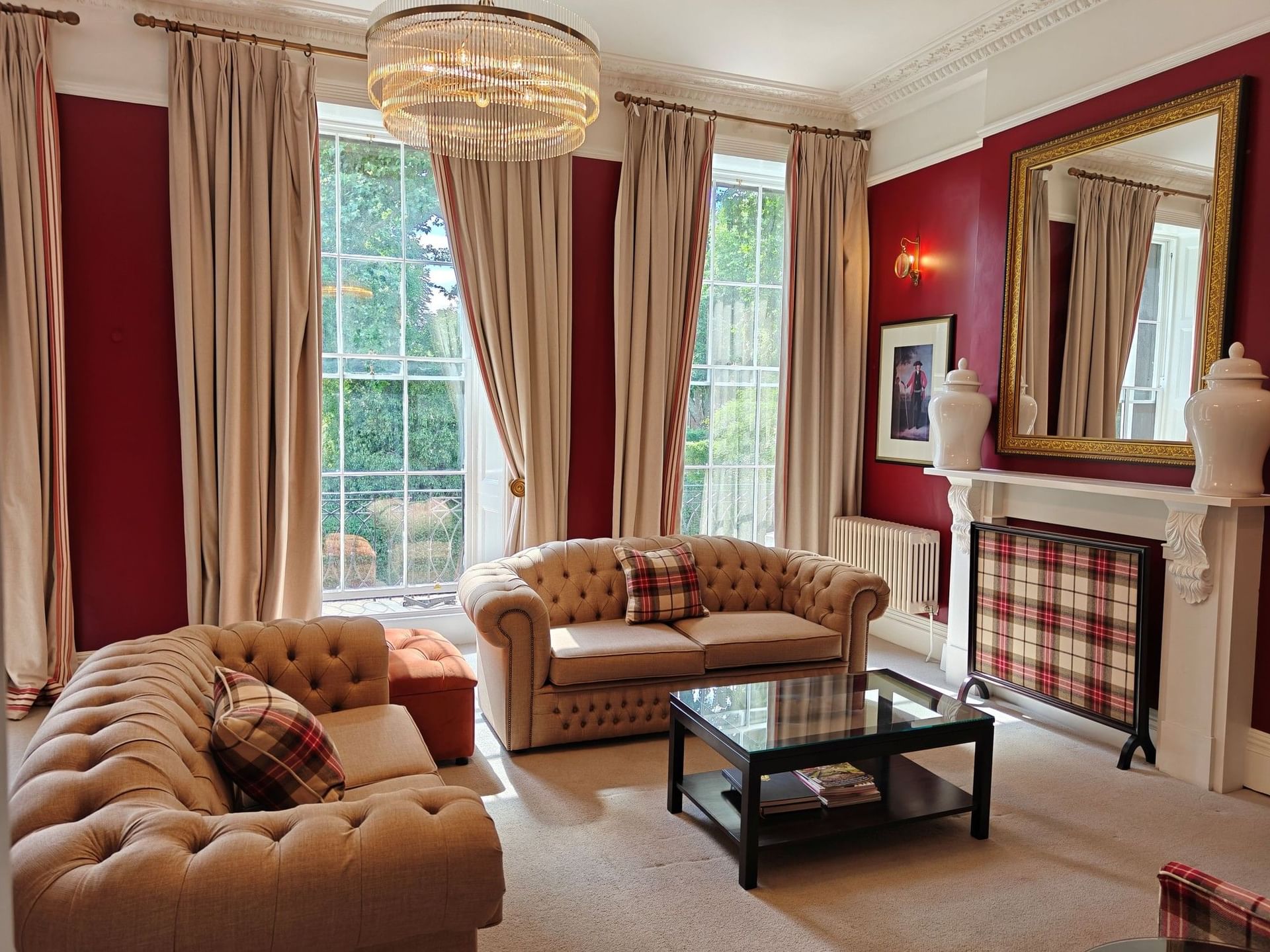
Staying with Dorothy
When we redesigned this suite, we wanted it to feel as though Dorothy L. Sayers herself might have approved.
The rich crimson walls and elegant Art Deco chandelier evoke the confidence and sophistication of the London she embraced during the 1920s. Rather than portraying Sayers as one of the fashionable "Bright Young Things", we have taken inspiration from the substantial, intelligent and accomplished woman she was: elegant without extravagance, scholarly yet full of life.
The bookshelves have been carefully curated to continue her story. Alongside biographies of Dorothy L. Sayers and her own novels, you'll find mysteries by fellow members of the Detection Club and guides to Bloomsbury, inviting you to explore the neighbourhood in which her life as a Londoner and detective novelist began. Morris-inspired brass and marble library lamps add a suitably scholarly touch, while the Clouseau lights beside the fireplace provide a rather more playful nod to the enduring appeal of the detective.
And then there are the clues. Look closely at the botanical prints and you'll find two beautiful but poisonous flowers: foxglove, a familiar source of danger in crime fiction, and lily of the valley, another literary poison and, rather delightfully, Agatha Christie's favourite flower. A small tribute to Sayers' fellow queen of the Golden Age, hidden in plain sight.
There are other clues tucked around the room too, waiting for curious guests to discover them.
Even the carpet has a story. The wonderfully soft Aruba underfoot is made using yarn created from certified ocean-bound plastic waste. Its quiet, natural texture grounds the suite’s rich crimson walls and Art Deco details, while reflecting our belief that beautiful, characterful interiors and more thoughtful choices can happily coexist.
We hope you'll enjoy discovering Dorothy L. Sayers, and perhaps leave inspired to follow Lord Peter Wimsey through the very streets that first brought him to life.
With grateful thanks to Professor B. J. Rahn, President of the Dorothy L. Sayers Society, for her advice and insights during the preparation of this page.